
Someone tells you ten nice things and one criticism. Which one do you take to bed with you? The criticism. It’s no coincidence, and it doesn’t mean you’re a negative person: it’s the negativity bias, your brain’s tendency to give more weight to the bad than to the good. And the good news is that it can be trained.
One criticism weighs more than ten compliments
The negativity bias creeps into very everyday situations. A meeting where everything goes well until someone raises an objection. A message full of affection with one comment that didn’t sit right with you. At the end of the day, what keeps coming back to your mind isn’t the compliments, but that one phrase that hurt.
The most curious thing is that, if someone asked you, you’d be able to say the overall balance was good. You know it. But it’s not what you feel. That gap between what you think and what stays with you is exactly where the negativity bias does its work.
It’s not that you’re negative: your brain works this way
Holding on to the criticism says nothing about your character. The negativity bias is a way of working that we all share: the bad grabs our attention more than the good and stays with us for longer.
Understanding this changes the way you look at it. Instead of blaming yourself because you «always hold on to the bad», you can recognise that your brain is doing what it knows how to do. From there, the question is no longer what’s wrong with you, but what you can do about it.
The negativity bias goes back a long way
Thousands of years ago, paying attention to danger saved your life. Whoever spotted a threat first had a better chance of making it, so being on alert for the bad was an advantage. The negativity bias is the footprint of that survival mechanism.
Today there are no lions, but your brain is still on alert. What used to be a predator in the grass is now a comment from your boss, a look at a family dinner or a message that takes a while to arrive. The alarm of the negativity bias goes off just the same, even though the real danger is much smaller.
When the negativity bias becomes a problem
The bad standing out isn’t a flaw in itself. The problem comes when a single criticism weighs more than everything good. If it happens now and then, it’s just a bad moment. If it happens often, the effect builds up.
Little by little, you end up seeing yourself as worse than you are. Criticisms add up and compliments are forgotten, and the image you build of yourself is left with only part of the story. That’s when the negativity bias stops being a curiosity of the mind and starts to affect how you feel every day.
Three exercises to train your attention
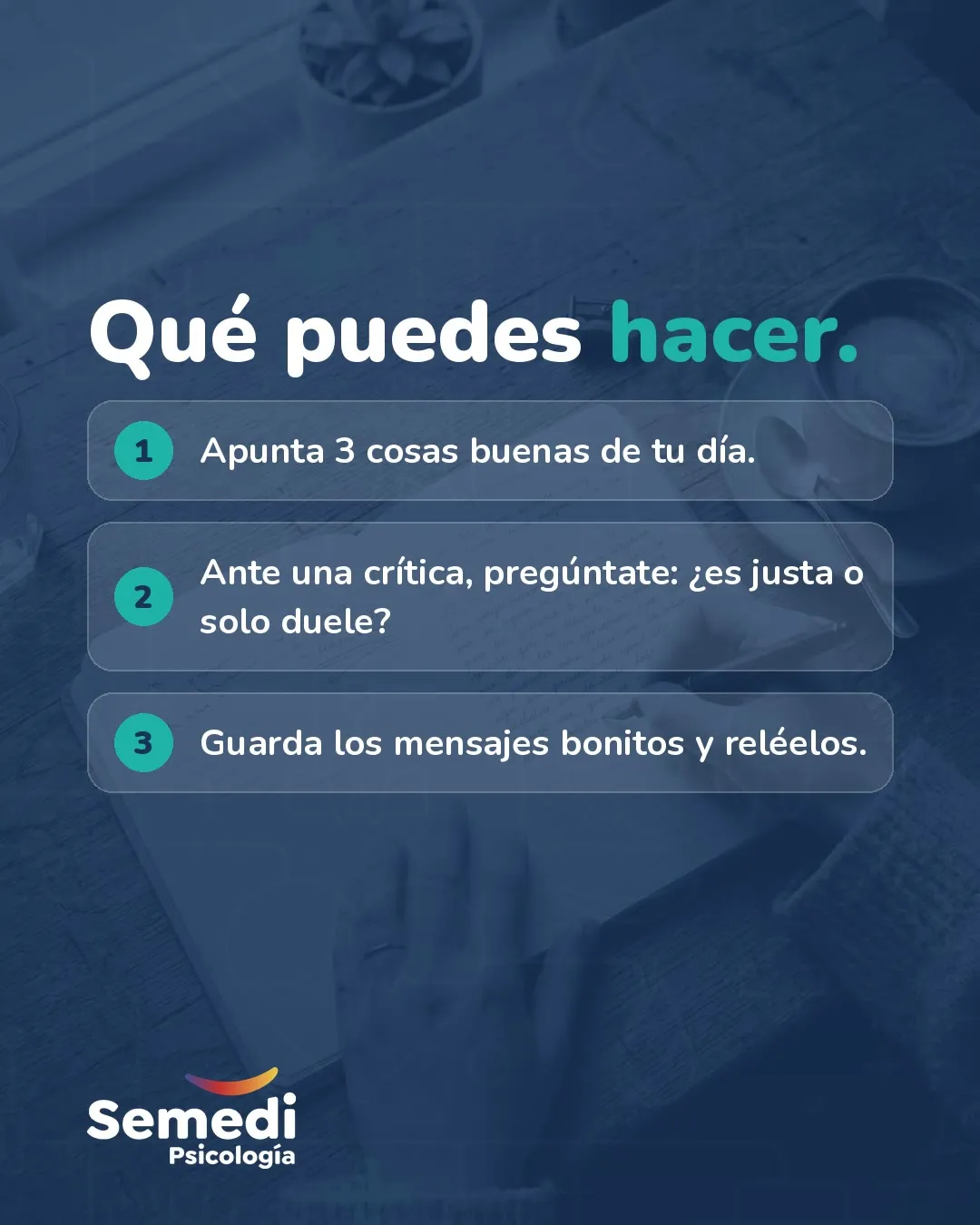
Just as the brain learned to focus on the bad, it can also learn to give the good its proper place. It’s not about ignoring criticism, but about balancing the scales. These are three simple habits to get started:
- Write down 3 good things from your day. Small or big, it doesn’t matter. Writing them down makes you look for them, and what you look for every day ends up catching your attention more.
- When you get criticism, ask yourself: is it fair or does it just hurt? Not everything that hurts is true. Separating what helps you improve from what only does harm helps you avoid carrying more weight than you need to.
- Keep the kind messages and reread them. If the bad is remembered on its own, the good needs a nudge. Having those words at hand lets you go back to them when criticism starts taking up too much space.
These are exercises to do consistently, not a magic solution. With practice, the negativity bias doesn’t disappear, but it stops deciding for you what you remember about each day.
Talking about it helps: psychology at Semedi Salud
Some criticisms weigh more than others, and sometimes the harshest ones are those you make of yourself. If you notice that the negativity bias shapes how you see yourself or how you relate to others, talking it through with a professional helps you understand where it comes from and work on it with tools tailored to you.
At Semedi Salud, we listen. We are on the 1st floor of El Corte Inglés in Málaga and you can book an appointment on 952 395 363. If this is the first time you’re thinking about taking the step, our guide on going to a psychologist in Málaga may help, and if what you find hard is saying no, there’s also how to set boundaries without guilt.
Frequently asked questions
Does it happen to everyone or only to insecure people?
It happens to everyone. The negativity bias is a way the brain works, not a personality trait. What changes from one person to another is how much it affects them and how much space they let it take up.
What if the harshest criticism is the one I make of myself?
That’s very common. You can ask yourself the same question you would about someone else’s comment: is that inner voice fair or does it just hurt? If self-criticism is constant, it’s worth working on it with a psychologist.
Where is the psychology practice?
On the 1st floor of El Corte Inglés in Málaga. You can book an appointment by calling 952 395 363 or write to us from the contact page.